Coaching Hockey
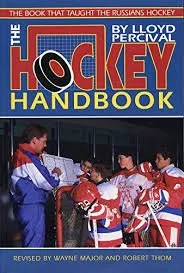
The Hockey Handbook by Lloyd Percival
Best Quote: “The Young hockey player, with few exceptions, loves to carry the puck and score goals. When he comes home after a session at the local rink, he tells his folks about how hard he can shoot or how shifty he is. He rarely says “Boy, you should see my poke check,” or “You should have seen me take my man out.”…this is the main reason why good defensive players are hard to find.”
Summary: For all the credit Tarasov receives for his innovations, most of his thoughts evolved from the writings and discussion with Lloyd Percival. Percival was a pioneer in the world of fitness, and wrote this book in 1951. His book would become the most significant and influential for the development and evolution of hockey. The Hockey Handbook was the first to break down the importance both on ice and off ice conditioning, and to develop a method for tactics in the ice. Today’s programs such as power skating with a focus on edgework and balance have their roots in The Hockey Handbook.
More than a handbook for skaters, Percival would also include writing on goaltending, how to play and how to practice, revolutionary at a time when most goalies relied on their athletic ability alone.
This book’s influence included the rise of and development of Soviet and European hockey, and was paramount in helping the Soviets catch up to North American hockey in competition and success. NHL teams adopted Percival’s ideas, including the Red Wings and North Stars, and players such as Gordie Howe and Terry Sawchuck.
Percival’s book is as relevant today as it was when first published, and is a must read for anyone looking to understand and coach hockey at any level of the game.
How to Play Hockey: A Guide for Players and their Coaches by Tom Watt
Best Quote: “When you are handling the puck on your stick, it is important to keep your head up.”
Summary: Tom Watt, who began his hockey career as a scout for the Toronto Maple Leafs back in 1935, who coached the University of Toronto hockey team for 15 seasons, and who and would coach in the NHL for 11 seasons (winning the Jack Adams Award for best head coach in 1982), and who won a Stanley Cup as an assistant coach of the Calgary Flames in 1989, provides the reader with a guide into the fundamentals of hockey. Published in 1971, Watt’s focus is not on systems, but rather the core mechanics of playing the game from skating to where to aim when shooting the puck. Watt writes about the the basics of skating including edge control and stride efficiency, discusses puck handling, passing, and shooting. Watt further writes on some positional play, which can be a bit outdated as hockey moves towards the positionless approach to the game (Watt’s era had players staying in their respective lanes, like a kickoff in football). Defensive and offensive responsibilities that Watt outlines however remain relevant today, no matter where a skater lines up on a faceoff. Watt finishes the book with a discussion on coaching philosophy, which is dated and speaks to the “dump and chase” theory of his era. Overall, Watt’s book is key to understanding how coaching, and the game of hockey evolved over the past half-century.
Behind the Bench: Coaches Talk About Life in the NHL by Dick Irvin
Best Quote: Tom McVie: “I have 4 guys who don't understand a word I'm saying, 10 guys who understand but don't do a thing a tell them to do, and another four who aren’t good enough to do what I tell them to do.”
Second Bet Quote: Ron Smith: "Every Coach is an Interim Coach"
Summary: Legendary coach and voice of Hockey Night in Canada talks hockey and coaching philosophy with some of the best coaches of the 70s, 80s, and 1990s to include Don Cherry, Mike Keenan, Gary Green, Al Arbor, Barry Melrose, Pat Burns, Glen Sather and Scotty Bowman. Each coach talks provides perspectives on what motivates players, how to manage various personalities, and how to keep their sanity in a stressful career.
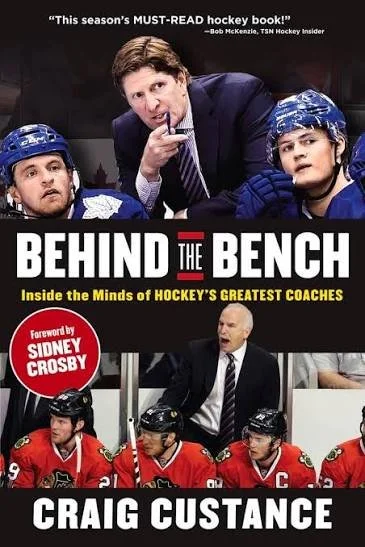
Behind the Bench: Inside the Minds of Hockey’s Greatest Coaches by Craig Custance
Best Quote: “You never know where you’re getting your best idea. It could be from your rookie player, it could be from your power skating instructor, it could be from the guy who cooks breakfast. You have to be open-minded.”
Summary: Another hockey book that is more in the lines of a leadership book. Behind the Bench is a look at the minds and methods of eleven of the best hockey coaches in the game today. More than a discussion of Xs and Os, Custance takes a unique perspective, and turns a hockey book into a leadership book, similar to what one would find in the business section of the local Barnes and Noble. Custance leadership themes that run throughout the book include the ability to manage talent, the role of luck, and the role of self-reflection, enabling leaders to engage as lifelong students of their profession.
Tape to Space: Redefining Modern Hockey Tactics by Ryan Stimson
Best Quote: “Ideally, positions shouldn’t matter. From when they are first starting out, children should be taught how to read and react to various situations regardless of their designated position.”
Summary: The author takes a different look at how hockey should be played. In defiance of conventional wisdom, the author advocates for fewer systems and less defined positions in favor of players who can constantly stay in motion, read the opposing team and developing plays and skate accordantly. Five players acting as one in lieu of disparate offense and defense positioning. The innovative concepts in this book are not however appropriate for youth level, but rather for advanced higher level leagues, high level juniors, college, and professional hockey.
Belfry Hockey by Darryl Belfry
Best Quote: “Often we don’t really know what “good” is until we see someone who’s actually good, and that goes for everything…. if you can skate and pass the puck, you can play at any level.”
Summary: A book for coaches that are looking to use more advanced ways to train their players and their teams. Belfry offers his ideas on how to slow drills down to focus on technique and skills then speed them up to game type situations. Indeed, the focus of this book is on individual player development, and zones in on how players can develop an authentic identity, develop translatable skills (a practiced mechanic that translates directly to in-game situations), and a concept that Belfry refers to as “Leading from Behind” where coaches help or guide players to move towards self-corrections.
Belfry Offense by Darryl Belfry
Best Quote: “once in the offensive zone, we let the players be creative.” That is not creative in my book. Hockey is a team game, so creativity has to be viewed as a group. If it isn’t a group and it’s disconnected and disjointed and one player starts being “creative,” it’s not actually creativity they’re expressing, it’s selfishness.”
Summary: In Belfry Hockey, the author provided his broad philosophy of the game, in Belfry Offense, the author moves to the next echelon of play and details his ideas for having a team philosophy. The book is a playbook of sorts, but not one of Xs and Os, but rather an innovative framework for an overall game strategy. A strength of the book is Belfry’s ability to look for root causes of a team’s struggles. Trouble entering the offensive zone may begin with the initial breakout. More often than not the struggles begin before what appears on the ice.
Let Them Lead: Unexpected Lessons in Leadership from America’s Worst High School Hockey Team by John Bacon
Best Quote: “I don’t buy for a second the notion of “quality time.” There’s only time, and wherever you spend it, that’s what you care about—and everyone knows it.”
Summary: John Bacon spends a year chronicling how he turned a historically bad hockey team to a constant championship contender. While the book certainly paints a picture of Michigan high school hockey, it is more of a leadership book whose lessons can apply to business, the military, or any other organization that prides itself on leader development. Bacon details how he implemented simple rules, changed the culture of his team, and gave ownership of the team’s outcome to the players. His book is a nice reminder that the ultimate form of respect is self-respect. And when your team respects itself, the possibilities are endless.
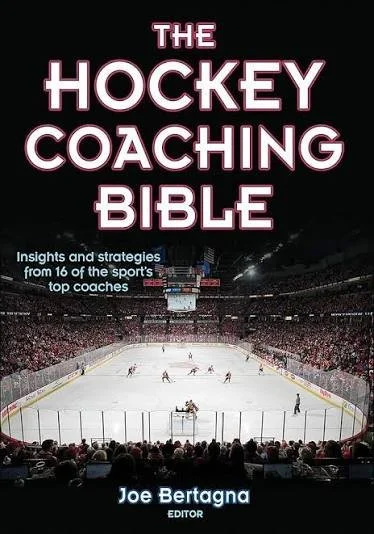
The Hockey Coaching Bible by Joseph Bertagna and Joe Bertagna
Best Quote: “A professional doesn’t expect to be paid by the hour. Early in my career, I was told to never add up the hours and figure out my hourly rate because I would always be disappointed. We are paid to get the job done.”
Summary: This book pulls together the philosophies of various coaches on what it takes to build a winning hockey team. There is a wide range of information in the book, as each chapter covers different aspects from on ice tactics to building a successful team culture. Further, chapters discuss player development for various positions (forwards, defense, goalies). A worthwhile book when thinking about how to lead, manage, and build a successful hockey team.
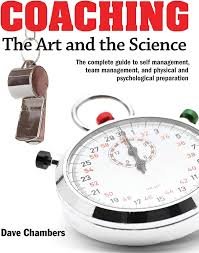
Coaching: The Art and Science by Dave Chambers
Best Quote: “Not all situations in sports are serious, a good coach should have a sense of humor.”
Summary: The author, a coach with 40 plus years of experience at the highest levels to include with the National Hockey League offers the reader his insights and wisdom accumulated throughout his career. The book is not hockey specific, but given Chambers’ background, deserves to be included within this section. Chambers breaks his book down into multiples sections inclduding talent identification time management, motivation adn communication, team organization, performance science, and physical training. Moreover, the author gives tips on off-ice or
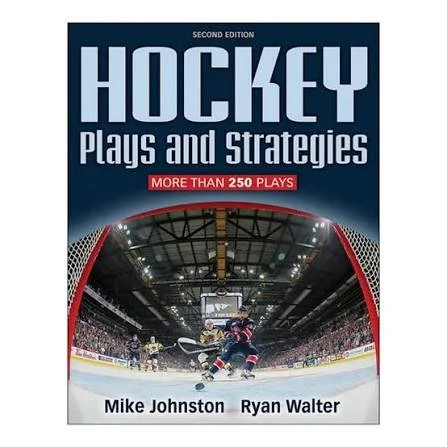
Hockey Plays and Strategies by Mike Johnston and Ryan Walter
Summary: Hockey is a game of flowing situations. A book that details various plays, from breakouts to special teams play, conducting and defending odd-man rushes, zone entries, and set plays from each faceoff dot, this book provides a coach options in almost every situation to practice. In football, where thinking is done from the coach on the sidelines, in hockey, players must constantly think and adapt while skating on the ice. This does not mean fire-wagon hockey, but rather seeing and understanding situations as they develop on the ice, and rehearsing each of them so one can dictate the flow of the game. Johnston and Walter’s book is an excellent analysis of each scenario that can arise in a game, and how coaches and teams can practice each play and strategy.