Hockey Memoirs
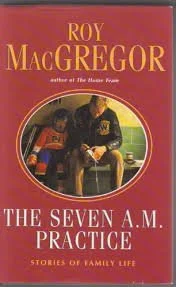
The Seven A.M. Practice by Roy MacGregor
Best Quote: “We can’t win at home, we can’t win on the road. My failure as a coach is that I can’t think of anywhere else to play.”
In this book, the author tells his own tales of being a parent and supporting his children in their youthful endeavors, which of course means driving kids to practice before the sun rises in frigid winter mornings. The book serves as a reminder to those currently watching our children grow up on the ice rink, the baseball diamond, the tennis court, or the football field that these are the golden years of parenthood, and for most kids who will never go on to play at the highest levels, it is their golden years of sports. The 7 A.M. practice may suck at the time, but when their gone you will spend the rest of your life wishing to have them back.
Tropic of Hockey: My Search for the Game in Unlikely Places by Dave Bidini
Best Quotes: “Sports taps into emotions we guard for the rest of our waking hours. Those who play sports, or who pledge love for their favorite teams, often find it impossible to express these feelings to wives, husbands, or children. We use games to vent our spirit, behaving in ways we can’t at work or home.”
Though we frame sport as singular events, they exist in a realm of perpetual play. Wins become losses that become victories. The score is inconsequential as long as you keep playing.”
Summary: An interesting travel type book that chronicles the author travelling to unique places to play hockey. In some ways this book is a travel memoir or travel blog and less a hockey book. But the best sports writing is when you write about something other than is tangential to the sport. Bidini tells us about his playing in seventh story of a mall in Hong Kong, in the city of Harbin in northern China, in Dubai in the desert of the United Emirates, and on to Transylvania, where the game is a war between Romanians and ethnic Hungarians, who were introduced to hockey by a 1929 newsreel of Canadians chasing the puck. Each rink has its unique story, some with strange designs and locations, and others with odd rink rats that you find in ice complexes throughout North America. It’s a fascinating tale and serves as a good reminder that no matter where you find yourself on earth, you can find someone like yourself.
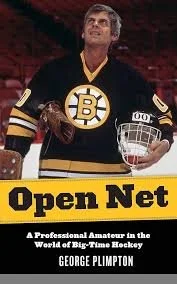
Open Net: A Professional Amateur in the World of Big Time Hockey by George Plimpton
Best Quote: “as a kid you were looked at differently if you raised your hand and made the choice to play goal. No one else wanted to play goal, so the volunteer instantly acquired a certain status identified with sacrifice and self-assertiveness—the kind of awe that surrounds the soldier who in the trenches gulps and announces that he will go over the top that night and take out the pillbox with a bazooka.”
George Plimpton is one of the best sports writers of the 20th Century. He has countless books where he joins professional teams to help explain to the average fan what life is like for professional athletes. In Open Net, Plimpton plays as a goalie on the late 1970s Bruins, whose head coach at the time was Don Cherry. Plimpton, as he does every time he embeds with a team gains unique insights into the minds and mannerisms of the worlds best athletes.
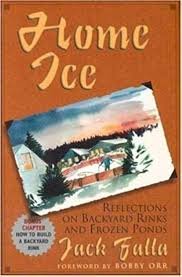
Home Ice by Jack Falla and Open Ice by Jack Falla
I group Jack Falla’s books together because if you read one then you will read the other.
Best Quote: “I’ve never been unhappy on the rink”
Home Ice is a collection of essays that center around Fall’s backyard rink. The rink serves as the main character who is at the center of Falla’s life events. The rink provides everlasting memories for the author as a husband, as a father, and as a friend to all those around him.
Open Ice is more of a collection of essays that describe Falla’s personal relationship to the game. Like any great sports writing the book is about something more than hockey. Open Ice is about family relationships, relationships to friends, and how gaps continually open and close within them. When you are apart of the game for 50-years, it becomes apparent that you can’t separate the personal and professional aspects of the game. Hockey is part of who you are, how you relate to other people, and how you mark the steps of your life.
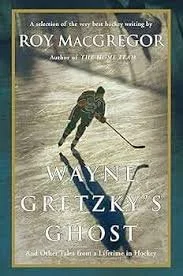
Wayne Gretzky’s Ghost: And Other Tales from a Lifetime in Hockey by Roy Macgregor
Best Quote: “Hockey is the dance of life, an affirmation that despite the deathly chill of winter we are alive.”
Second Best Quote: “Goaltenders form almost a secret society within the hockey world, so caught up in their own world that they have virtually created a second one for themselves.”
After Wayne Gretzky retired from playing hockey, Roy MacGregor was hired to ghost write some articles for #99 the following season. The book has these columns, then expands to include the author’s works over several decades.
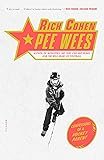
Pee Wees: Confessions of a Hockey Parent By Rich Cohen
Best Quote: “He can’t skate the cones and doesn’t nail the drills. All he can do is play hockey.”
Summary: Rich takes the time to tell the story of his son’s year in Pee Wee hockey. His son plays in Fairfield Connecticut, a fairly wealthy suburb of New York City. Throughout the book Cohen details some of the insanity that is filling the ranks of youth sports. The pressure cooker of tryouts that tell very little about character, leadership, and work ethic…the most important traits of a hockey player. The book is brutal in its honesty, and covers the inside look at youth sports politics, the competitive nature of youth sports, and the crazy schedules filled with early mornings and long road trips. Indeed, the author finds himself unwittingly writing critiques of other kids on his son’s team, one of the very acts he bemoans, exposing just how the pressure of youth sport can corrupt thinking and judgement.
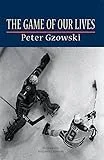
Game of Our Lives by Peter Gzowski
Best Quote: “If you ever want to sum up hockey players, just try to remember the last one who ever asked you how you were.”
Summary: A fascinating insight into the Edmonton Oilers 1980/81 team. The author follows the team throughout the season writing on such players as Wayne Gretzky, Mark Messier, and Paul Coffey. Before the Oilers transcended into a dynasty they were young players still finding their way in the league. Paul Coffey, a Hall of Fame Defenseman for example, spends time and energy worrying he would get sent down to Junior-A and never play in the League again. The author’s has intimate access with players and coaches which helps him provide detailed insights into how players see and understand the game.
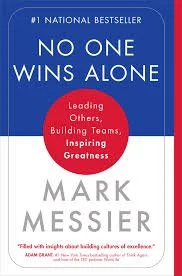
No One Wins Alone: A Memoir by Mark Messier
Best Quote: “he was mindful of another painful recent lesson he’d learned. One minute you’re one of us. The next minute, you’re a guy in a suit who doesn’t play. You might have played once, but this isn’t what you do anymore. There’s a bigger wall there than you’d expect.”
Summary: A recap of the hockey life of one of the greatest players and leaders in the game. Messier takes the reader from his time in youth hockey through all the success of the 1980s Oilers and through his time leading the New York Rangers to their first Stanley Cup in 44 years. A professional career that spanned 25 years. The leadership Messier developed began with lessons from his father Doug, who also played at the professional level and was a minor league coach. So more than a memoir, the book serves as a foundational leadership book,, where Messier harps on the importance of empathy, respect, and the need to empower everyone on the team.
Winter: Five Windows on the Season by Adam Gopnik
Best Quote: “In no other sport can a quality of mind so dominate as in the supposedly brutal game of ice hockey. Hockey is the one game where an intelligence can completely overthrow expectations.”
Second Best Quote: “A parking lot is a cemetery of civil society.”
Summary: This book is a collection of five distinct essays on winter, the season of hockey. Gopnik breaks winter down into five subcategories; Romantic Winter, Radical Winter, Recuperative Winter, Recreational Winter, and Remembering Winter. It is within Recreational Winter that Gopnik tells the tale of the relationship between winter and hockey.
The Home Team: Fathers, Sons, & Hockey by Roy MacGregor
Best Quote: “When I look up, I see my father, and I see what he is dreaming: Dunc, forever young, skating faster and faster through life”
A profound story of some of hckey’s greatest stars and their relationship to their fathers. The book tells the personal tale of these relationships with Wayne Gretzky, Mark Messier, Paul Coffey and Marty McSorley during their famous tour of Europe. Other families discussed in this book include the Howes, the Hulls, the Dineens, and the Drydens. The story if the Hulls stands out with the telling of Bobby Hull (the Golden Jet) and his troubles marriage along with his absentee relationship with his son Brett.
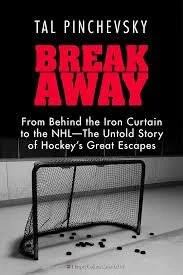
Breakaway: From Behind the Iron Curtain to the NHL—The Untold Story of Hockey's Great by Tal Pinchevsky
Best Quote: ““I've learned to expect nothing from the Russians and I am never disappointed,”
Summary: Pinchevsky details the early years of Eastern European hockey players and their defections to the NHL. Before the famous Russians such as Federov, Larionov, and Fetisov, there were the Stastnys of Czechoslovakia, Petr Klima, and Peter Bondra. In some ways the details of how these players were able to defect to the West to play in the NHL reads like a spy thriller as players had to avoid the never blinking eye of the KGB and other communist nation agencies. The book is easy to follow as each chapter presents its own story behind various players and their journey (often with their family) from the grips of the Iron Curtain to the ice sheets of the NHL.
Burke’s Law: A Life in Hockey by Brian Burke and Stephen Brunt
Best Quote: “He was always three steps ahead. Visionaries look and see the next mountain and ask, “How do we get there?” Gary looks ahead and sees six mountains.
Summary: In this book, Brian Burke, architect of a Stanley Cup winning Anaheim details his thoughts on the best way to build a hockey team and to compete for the Stanley Cup. Along the way Burke tells the story of his hockey career, one in which he comes across all the famous names in hockey. Burke discusses how he had to deal with the league, other coaches, and the media as a General Manager. The flaw behind Burke’s theory of building a hockey team is that it’s meant for a bygone era. In the age of free-agency, general managers and head coaches must work with the players they can accumulate and modify their system to the talent they have, not the talent they wish to have (to paraphrase Don Rumsfeld’s quote of “You go to war with the army you have, not the army you wish to have”).
The Final Call: Hockey Stories from a Legend in Stripes by Kerry Fraser
Best Quote: “We joke in the officiating business that NHL really stands for No Home Life.”
Summary: Kerry Fraser walks the reader through his final season as a NHL referee, a career that spanned three decades. The layout of the book is that Fraser brings his audience to each rink in that final season, and uses that arena to tell some of his best anecdotes and stories of his time in zebra stripes. Fraser tells of meeting and interacting with the greatest coaches and players in the game, including Gretzky, Lemieux, Al Arbor, Scotty Bowman, Marc Crawford, and Al Arbor. but also reflects on some historic moments he was a part of, to include the famous missed high stick call (Gretzky on Gilmore) call of the 1993 Conference Finals, and later in that playoff year the famous measurement of Marty McSorley’s stick. Fraser also used his writing to thank his family, friends, and colleagues, a theme found throughout the book.
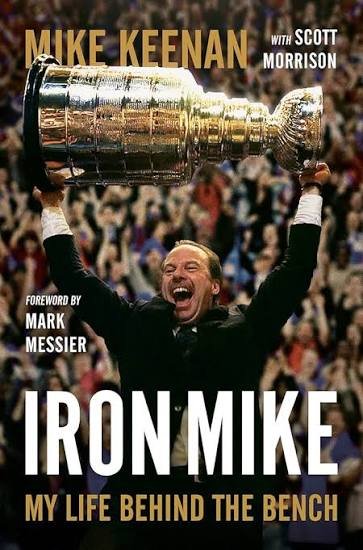
Iron Mike: My Life Behind the Bench by Mike Keenan
Best Quote: “I once had a player on my fourth line who came in and asked why he wasn’t getting more ice time and why he was on the fourth line. I said, “Do you really want me to tell you?” He said yes. I said, “Because we don’t have a fifth line. Get out.” Sometimes players overestimated their abilities or didn’t understand their role.”
Summary: A book by Mike Keenan who really, and I mean really comes close to understanding how toxic his leadership was, but doesn’t quite get there. Without a doubt, Mike Keenan understood how to get the most out of his players, but for a short period of time. He was able to bring his Flyers of the 1980s to the Stanley Cup finals, coach Team Canada in the 1987 Canada Cup, and eventually lead the 1993/94 New York Rangers to their first Stanley Cup in 54 years. But at each stop his tenure was short lived. He was abusive towards his players, was a one trick pony in terms of telling every new player they were fat and out of shape. HE was reflective in some ways, especially in seeing how he treated players coming from Europe, and that they might not have an understanding of Western culture (the Russian players specifically). Keenan’s break down of ice time per player and line is something coaches at all levels should understand, and break down to players (and parents in youth hockey).
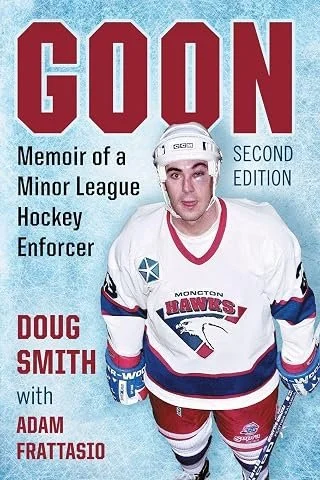
Goon: Memoir of a Minor League Hockey Enforcer by Doug Smith
Best Quote: “"You certainly don't have to be a hockey player to be a good fighter”
Summary: This is the memoir of Doug Smith, a professional hockey player that didn’t learn to skate until he was 19 years-old. The book chronicles his rise though the hockey ranks from the ECHL to the IHL to the AHL and on to the National Hockey League. At each level, his job description was fairly simple, to drop his gloves and fight the opposing teams enforcer. Smith understood his role, and uses his writing to describe the immense mental toll that fighting takes on a hockey player, including the anxiety before every game knowing what he was expected to do. Smith goes beyond the description of the fighting and discusses what he sees as a brotherhood amongst hockey players, and the knowledge that the hockey locker room (especially at lower levels) is one of the happiest places on earth. While the book inspired the comedic 2011 movie Goon starring Seann William Scott, the book is far more reflective and grounded.
The Best Game You Can Name by Dave Bindini
Best Quote: “That it is even called “Pro Shop” is ironic considering the caliber of players who frequent the rink.”
Summary: Dave Bindini is a musician and writer who takes the time to present an homage to the game of hockey. There are two aspects to this book, the first being a narrative of the author’s beer league team, the Morningstars as they make their way through Toronto’s Exclaim! Cup , a beer league tournament. While guiding the reader through the tournament, Bindini presents an oral history of the NHL, using first person interviews with former NHL players from the 60s, 70s, and 80s, including Frank Mahovlich and Yvan Cournoyer. However, Bindini’s focus gears towards NHL fringe players, those who constantly had to look over their shoulders in fear of being replaced at any moment, in some ways reminding the reader that any competitive sport, no matter how much team play is necessary to win, is always in some way an individual undertaking.
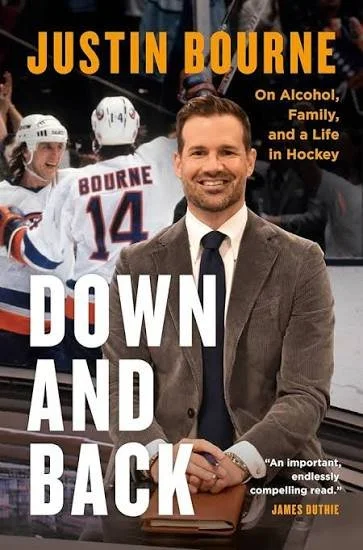
Down and Back: On Alcohol, Family, and a Life in Hockey by Juston Bourne
Best Quote: "Fresh ice always was, and remains, my number one favourite thing about being a player. The first satisfying cuts into unspoiled slate, feeling the cool air on my face, and dumping a bucket of pucks to begin anew was just so pure. Handling that first puck and physically expressing your best-developed talent is therapeutic. Anything can happen, and that freedom feels exhilarating.”
Summary: Bob Bourne won four Stanley Cups playing for the early 1980s New York Islanders. He was a key piece of the puzzle of the dynasty that won 19 consecutive playoff series, a record unlikely to be equaled in any sport. Bob Bourne was also an alcoholic. In this book, his son Justin Bourne details his life in hockey, from growing up around professional athletes to his own junior and professional hockey career on and off the ice, to his own troubles and struggles with alcohol. In addition to his insights on the game of hockey (explaining the difference in talent between the ECHL, AHL, and NHL was a gem), Bourne is open and honest in detailing his addiction, how it cost him personal relationships and professional opportunities. In doing so Bourne exposes a dark part of sports, and hockey culture in particular. Indeed, the list of hockey players who struggle with alcohol and other substance abuse is extensive (e.g. Theo Fleury’s memoir). The redeeming aspect of the book is Bourne’s endless thanks to his wife and children who he credits for having helped him through his darkest moments.
The Code of the West: Lessons from the Ranch and the Rink by Darryl Sutter
Best Quote:
Summary:
Hockey Confidential by Bob McKenzie
Best Quote: “
Summary: