“Trust is the coin of the realm for creating the harmony, speed, and teamwork to achieve success at the lowest cost.”
― Jim Mattis, Call Sign Chaos
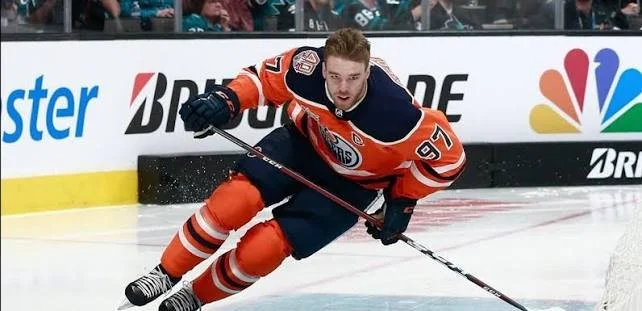
Hockey is widely considered the fastest sport on earth. Players on the ice move faster than world class sprinters. The puck moves at an even faster rate, as the game dictates that no one on the ice can outskate the puck, thus the necessity of passing. Moreover, the pace of the puck coming off the curved blade of a stick and head directly at a goalie can exceed 100 miles per hour. As fast as the game moves from one end of the rink to another, the most important speed for a successful team is the speed of trust.
Team chemistry, as described by Sam Walker in his book The Captain Class,is a team’s intrapersonal dynamics that impact the team’s performance. Hockey is the sport where team chemistry matters most. In baseball, players perform their job as individuals in the batter’s box or in the field. Pitchers and catchers must be on the same page, but by in large chemistry is a non-factor in baseball. Football requires the synchronization of 11 players on the field, but again largely demands that players execute their responsibilities on any given play. Chemistry matters more between quarterbacks and receivers, between the long-snapper, holder, and kicker on field goals, and within the offensive line, but not between all 11 on any given play. Basketball teams rely on the interaction of all five players, but evolved to an era where individual creativity trumps collective.
The necessity of team dynamics matters more in hockey than other sports, as in hockey the best forward on the team may only be on the ice for 1/3 of the game, the best defenseman fbeing on the ice for a little less than half the game. In basketball for example, the greatest players can average 40+ minutes of a 48 minute game, while in baseball, position players go the full 9-innings, and stay in the lineup in extra innings. Hockey is a sport where a team cannot rely on one player carrying the team to the championship, rather all players on the bench must contribute to the team. Hockey teams consist of wide ranges of talent and are composed of players who do different things, or excel in specific areas. On the ice, collective talent is greater than individual talent.
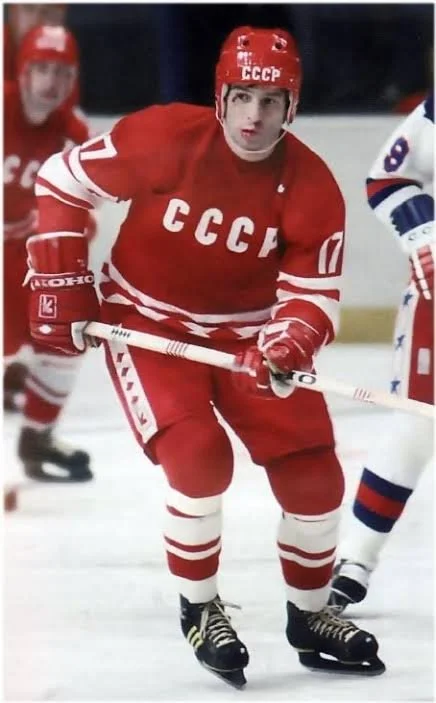
#17 Valeri Kharlamov
Hockey is indeed the fastest sport on the planet. The famous Soviet hockey coach Anatoli Tarasov once described three speeds of hockey, 1) speed of foot, 2) speed of hand, and 3) speed of mind, or the physical, the technical, and the mental. Indeed, Tarasov used these three speed descriptions to describe one of his greatest players, Valeri Kharlamov, and how Kharlamov was able to dominate on the ice. The speed of foot is the explosive skating speed, the edge work, and the agility a player demonstrates on the ice. The Speed of hand is rapid stickhandling, puck control at various speeds, accurate passing, and quick releases on a shot. Speed of mind is the hockey IQ, or spatial awareness, anticipation, and rapid decision making.
Tarasov’s Soviet hockey teams dominated international competition for decades. Their run of success was built on more than the speed of individual players, but rather built on systamatic trust. Soviet teams trained year-round, enabling players to develop a 6th sense of where their teammates would be on the ice. This allowed for a faster pace of play with passes and puck movement coming quick and often. Their success wasn’t just against inferior international teams, as the Soviets were competitive (wins and losses) in every series played against NHL (and WHA) competition. The speed of trust that Soviet hockey players operated on lasted well into the late 90s, with the Detroit Red Wings “Russian 5” line employed by Scotty Bowman.
The speed of trust incorporates all three of these dimensions, but advances further than what an individual can do skating, stickhandling, and seeing or understanding the game. The speed of trust occurs when a line, or a team can see and understand the game in a similar manner. When a team moves at the speed of trust, individuals are not concerned with taking risk, as they trust their teammate will adjust their positioning in reaction to what they see.
In hockey, the puck carrier is dependent on the four other skaters without the puck, while, as Tarasov described, he or she acts as a servant to the players without the puck. Players without the puck must continually move into constantly changing positions to open up passing lanes, and to provide time and space for the puck carrier. Indeed, the greater the number of passes, the higher number of times the opposing teams must react, change their positions, thus increasing the odds that they find themselves out of position and on the short end of an odd-man rush.
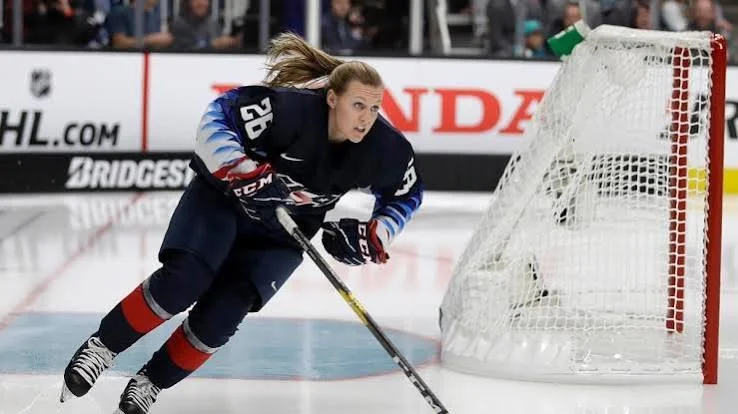
#26 Kendall Coyne-Schofield
The speed of trust is the pace or tempo that a hockey team can play at using all skaters on the ice. This speed is determined by players who understand the concepts and systems they are expected to play in and thus are in the right place at the right time to receive a pass moving about the ice. The speed of trust is not determined by individual rushes up the ice. The puck carrier must trust his or her teammates to be in or moving to the right position. In some ways as this rapport develops it turns into instinct. High levels of trust allow players to move the puck into the right area without needing the time to think.
The speed of trust can go in any direction, beginning anywhere from behind one’s own goal line in a breakout, or initiate in the offensive zone. A team moving at the speed of trust can move in any direction, again including breakouts up the ice, or resets and regroups while moving toward one’s own defensive end. A set play such as a hinge, or the 1-3 seconds after a face-off can incorporate the speed in various directions. When you know and trust where your teammate will be, and your teammates know and trust where you will be going, you open an advantage over the opposition.
Hockey teams at every level need leadership. From the head coach and his/her assistants, to the players that wear the “C” and “A” on their sweaters. Coaches and captains alike must take the time to build and guide trust within the team. The better the trust, the faster the team.