All Roads Home: A Life On and Off the Ice by Brian Trottier
Best Quote: “You can always come home.” -Brian Trottier’s Father

Summary: Brian Trottier is perhaps one of the more underrated great players of his time. He is recognized as a Hall of Fame Player (inducted in 1997), one who earned six Stanley Cup Rings as a player (4 x with the Islanders, 2 x with the Penguins), played in seven finals, and earned another ring as an assistant coach (with the Avalanche). During his time as an Islander, he earned the Calder, Art Ross, Conn Smythe, and King Clancy trophies. After retiring following his stint with the Penguins, he totaled 1,425 career points. His autobiography shares with the reader his time growing up in rural Saskatchewan, the value he places on family, and what he learned that led him to the hockey career he experienced. Trottier describes some of the relationships he built over the years through hockey, particularly his relationship with Tiger Williams, a fellow player who helped keep Trottier’s rising career on track. Indeed, the focus of the book is less on hockey or locker room stories and statistics, nor is it a tale of his multiple Stanley Cup runs, rather the writing focuses on Trottier’s values and his identity, which he considers central to his career success. Trottier writes nothing but praise for his contemporaries such as Al Arbor, Clark Gilles, Mike Bossy, and Mario Lemieux, which is central to the books key strength, a celebration of the relationships that give strength to hockey players.
Ken Morrow: Miracle Gold, Four Stanley Cups, and Lifetime of Islanders Hockey by Ken Morrow
Best Quote: “Just because you become captain doesn’t mean you have to change. Sometimes people make the mistake of trying to change. But the reason you were chosen is the person you are. Be yourself.”
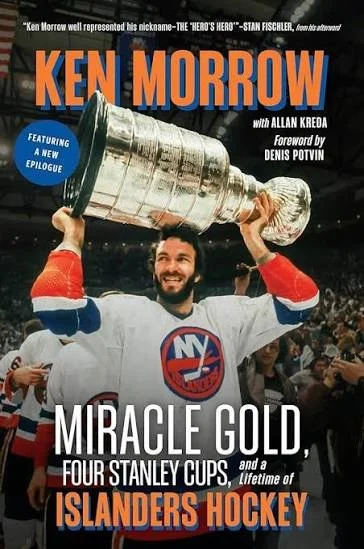
Summary: Ken Morrow is perhaps the most consistent and reliable defenseman from the 1980 U.S. Hockey team and from the 1980-1983 New York Islanders Stanley Cup Dynasty run. The title of the book comes from Kenny Morrow becoming the first player to win a Stanley Cup and Olympic Gold Medal in the same year, a feat he accomplished in his rookie season. The book walks the reader through Morrow’s childhood in Flint, Michigan to his time playing NCAA hockey at Bowling Green, through his time with the U.S. Olympic Team, and his career with the New York Islanders. Morrow’s themes are less tales of the locker room and inside gossip, and more focused on what it took to achieve his personal and team accomplishments. The book breaks down into three overarching narratives, Morrow’s “Miracle On Ice era, the Islanders Dynasty Era, then an expansion beyond his hockey playing days detailing his time as the Islanders’ director of pro-scouting. Always the humble player, Morrow’s book relies on some outside perspectives, including a written forward by the Captain, Dennis Potvin, as well as commentary from multiple coaches and players from his time in the league throughout the book. Understanding the perspective of a defenseman who was on the ice for the final seconds of Team USA’s victory over the Soviets, and who was central to a defensively focused Islander’s dynasty is what makes this book a central element to any Islanders fan’s bookshelf.
Rangers vs. Islanders: Denis Potvin, Mark Messier, and Everything Else You Wanted to Know about New York’s Greatest Hockey Rivalry (2016)
Best Quote: “The greatest moments in the legendary rivalry belong to the fans. The atmosphere in the building when these two teams met went far beyond simple sports banter; it was a territorial war played out in the stands of the Garden and the Nassau Coliseum."
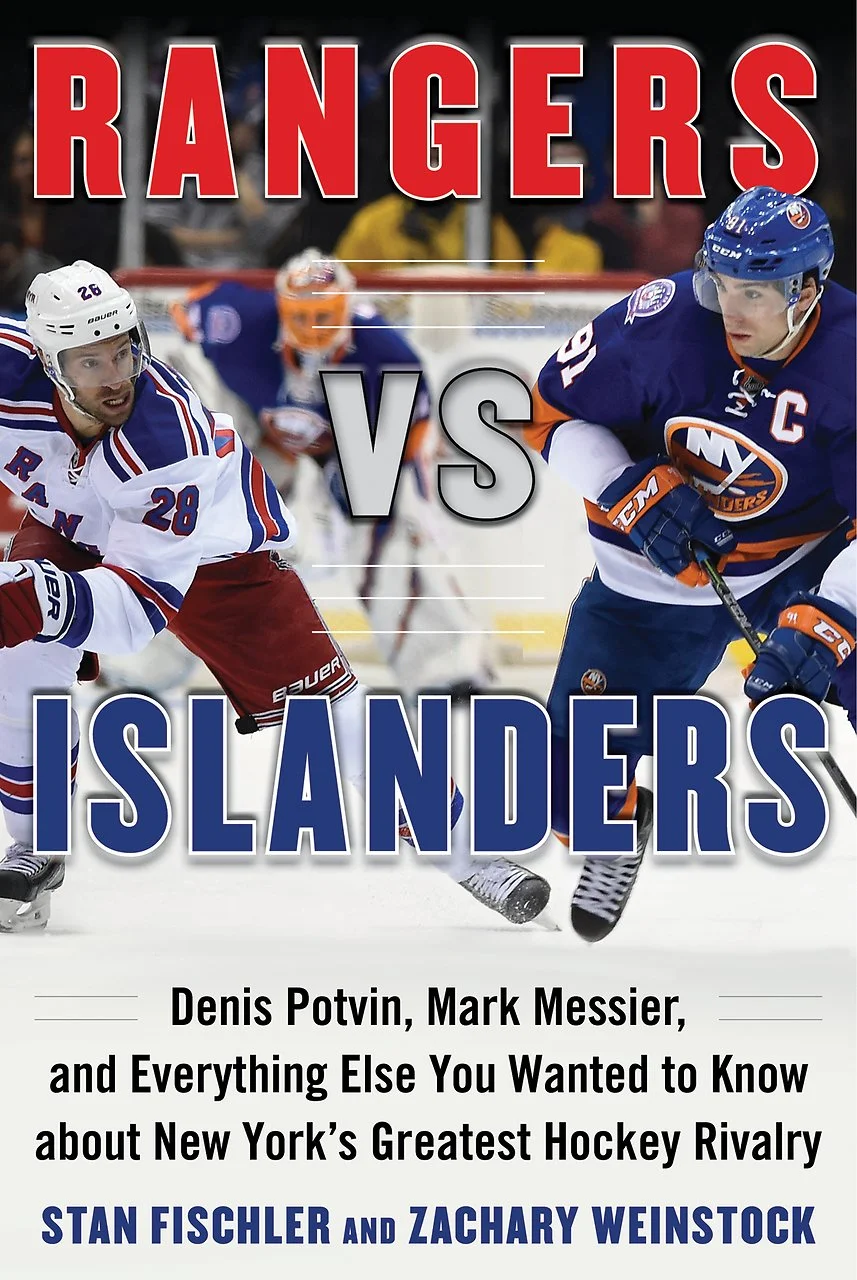
Summary: Published in 2016, this is one of Stan’s more recent books. Stan looks at the rivalry between the two teams that kicked off in the Islanders’ inaugural 1972 season. The two teams would play in the Patrick Division, and thus compete for a playoff spot against each other. They would meet in the playoffs eight times in the 1970s and 1980s, with the Islanders holding the upper hand, and of course earning four Stanley Cups to being the 80s decade. The rivalry included two legendary coaches of Herb Brooks (Rangers) and Al Arbor (Islanders). Lost in that time is the quality of those Rangers teams that at times were the second best team in the NHL, but could not overcome the best team of the dynastic Islanders. This burned inside Ranger fans who had not witnessed a Ranger Championship since 1940. This all would change in the 1990s, as the Rangers would win their Stanley Cup in 1994. Stan, with his inside vantage point to discuss on-ice and off-ice moments in the rivalry.
Hapless Islanders: The Story Behind the New York Islanders' Infamous 1972-73 Season by Greg Prato
Best Quote: “Arbour was a great teacher," remembers Harry Klaff. "For him, as being a defenseman, defense was everything. In fact, he knocked a hundred goals off the goals against from the year before – as did Barry Trotz, when he first came in [2018-19]. And that's a tremendous accomplishment. So, he taught defensive alignment, defensive strategy. That was the main difference – defense was on the first page, offense was secondary."
Summary: In their first season in the NHL, the 1972–73 New York Islanders, finished their expansion year with a 12-60-6 record. Greg Prato takes a deep dive into the season and ends up with a dark comedy. The Islanders were rushed into their existence to prevent a WHA team (WHA's New York Raiders) from taking over the Coliseum. For lifelong Islander fans, the book provides a narritive of forgotten early figures—like original head coach Phil Goyette and resilient players like Billy Harris, Ed Westfall (a 2 x Stanley Cup winner with the Boston Bruins), and Arnie Brown The critical takeaway, is that it’s always darkest before the dawn. The 12-win initial season set the stage for Islander general manager Bill Torrey to build the franchise in a disciplined manner through the draft. The awful record secured the #1 overall pick in 1973, leading to the draft selection of hall-of-famer Denis Potvin, hiring Al Arbour, and eventually building the 1980s dynasty.
Dynasty: The Oral History of the New York Islanders, 1972-1984 by Greg Prato
Best Quote: "What made us special wasn't just having elite goal scorers like Mike Bossy or a dominant defenseman like Denis Potvin—it was that every guy, down to the fourth line, knew their role and embraced it 100 percent."

Summary: From 1980 to 1983, the New York Islanders won four consecutive Stanley Cups. In 1979 the year prior to this run, the Islanders lost to the New York Rangers in the Conference Finals, and in 1984, the year after their Cup run, the Islanders lost in the finals to the next Dynasty, the Edmonton Oilers. A remarkable run that includes 19 strait series victories, a streak that may never be equaled. In this book, the author Greg Prato constructs a comprehensive, firsthand narrative of the Islanders’ meteoric rise from worst-in-the-league expansion team to an unstoppable hockey machine. The author provides first hand accounts as he features extensive quotes and commentary from Hall of Famers including Mike Bossy, Denis Potvin, Bryan Trottier, Clark Gillies, Billy Smith, and legendary head coach Al Arbour, alongside general manager Bill Torrey and key role players. With these narratives, the book offers insight into the locker room dynamics, prankster culture, playoff injuries played through in secret, and the distinct leadership styles of Arbour and Torrey. The book is essential reading for anyone who considers themselves a true New York Islanders fan.
We Want Fish Sticks: The Bizarre and Infamous Rebranding of the New York Islanders by Nicholas Hirshon
Best Quote: "If you’re winning, you can play with pink jerseys. It wouldn’t matter because you’re winning games.”
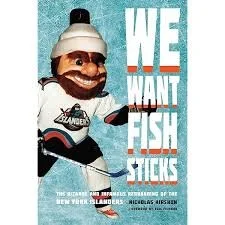
Summary: If there is a Mount Rushmore of terrible marketing decisions, the rebranding of the New York Islanders with a cartoon fisherman wearing a rain slicker and gripping a hockey stick. This decision ranks up there with New Coke and the Kendall Jenner Pepsi ad. This book is more of a business book than sports book, as the author provides the reader a case study in corporate and organizational failure. Indeed, Hirshon uses interviews with former executives, players, and designers to document how a complete lack of focus groups, market research, or fan engagement led the Islander’s management to misread their own fan base. Indeed, Hirshon describes how management not only misread the fan base, but continually double downed on their poor decision making. Much of this came from a 28 month era filled with bizarre tales including the infamous ownership scam involving John Spano, a fraudster who posed as a billionaire to buy the franchise without having the funds. Not only was there poor ownership, but the Islanders put their full faith and trust into Mike Milbury as head coach and general manager, who alienated his players, and along with the logo alienated the fan base. The Islanders made Milbury the face of the franchise, not their most successful player (Ziggy Palffy). The Islanders traded away talent for Kirk Muller, who refused to report to the team, and was later politely asked not to show up due to his lack of effort. Some takeaways from the book include an understanding of how team logos can also serve as sacred artifacts to a fan base, and how franchises should never underestimate the power of gaining endorsements from former players/legends of a team. However, the author also concludes with the tale of how the failed logo, like a failed movie can later become more of a cult classic and source of pride for later generations. Indeed, the fish sticks logo now occasionally makes an appearance as a third jersey for the beloved Islanders.
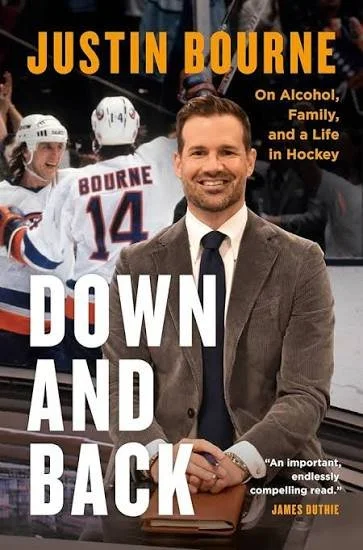
Down and Back: On Alcohol, Family, and a Life in Hockey by Juston Bourne
Best Quote: "Fresh ice always was, and remains, my number one favourite thing about being a player. The first satisfying cuts into unspoiled slate, feeling the cool air on my face, and dumping a bucket of pucks to begin anew was just so pure. Handling that first puck and physically expressing your best-developed talent is therapeutic. Anything can happen, and that freedom feels exhilarating.”
Summary: Bob Bourne won four Stanley Cups playing for the early 1980s New York Islanders. He was a key piece of the puzzle of the dynasty that won 19 consecutive playoff series, a record unlikely to be equaled in any sport. Bob Bourne was also an alcoholic. In this book, his son Justin Bourne details his life in hockey, from growing up around professional athletes to his own junior and professional hockey career on and off the ice, to his own troubles and struggles with alcohol. In addition to his insights on the game of hockey (explaining the difference in talent between the ECHL, AHL, and NHL was a gem), Bourne is open and honest in detailing his addiction, how it cost him personal relationships and professional opportunities. In doing so Bourne exposes a dark part of sports, and hockey culture in particular. Indeed, the list of hockey players who struggle with alcohol and other substance abuse is extensive (e.g. Theo Fleury’s memoir). The redeeming aspect of the book is Bourne’s endless thanks to his wife and children who he credits for having helped him through his darkest moments.