Road to Olympus proves the reader an inside view into the mind of a hockey genius. The book, written by the legendary Soviet hockey coach Anatoli Tarasov in 1969 (three years before the 1972 Summit Series) is a memoir of his time creating, building, and coaching Soviet Hockey teams to unprecedented and unmatched levels of sustained success.
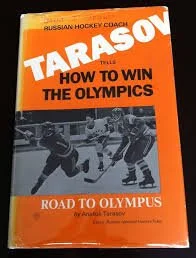
The book is part tactical guide and part memoir, and offers the reader a window into Tarasov’s revolutionary ideas. Within the book, Tarasov provides insight into his various teams and players that have won multiple International and Olympic championships. But more than a retelling of the various tournaments, Tarasov provides the reader with insights into his hockey philosophy including individual and team tactics, leading with the thought that the essence of hockey is a balance between teamwork and individual play.
Passing, for example was central to the type of hockey Tarasov would preach. Tarasov’s insight that every pass meant the defense would have to react and shift to the initiative of the offense was central to the Soviet way of hockey. Tarasov called the puck carrier the servant of the other 4 players on the ice, while reminding the reader that the game is then dependent on those 4 skaters to create opportunities and openings for the puck carrier. A second characteristic of Tarasov’s philosophy was courage. Tarasov saw courage not as the ability for a player to get in a fight, or lay a hard hit, but rather to keep a level head, absorb punishment, and to use that courage standing in front of the net to score.
More than on-ice performance, Tarasov details the importance of cross-training. Tarasov writes about the importance of including off-ice acrobatics, gymnastics, weight training, and multi-sport cross-training such as basketball and tennis. These ideas still hold water today, as it is important to be an athlete first, and a hockey/tennis/baseball player second.
An aspect that stands out in the book is the insight into the Soviet mind. Indeed, Tarasov’s writings mirror Soviet state ideology, as Tarasov frames his team building through the lens of a socialist and collective system. This type of thinking would handicap Soviet Teams over the decades, as the Soviet hockey system left little room for creativity beyond what Tarasov developed. The Soviet system was top-down, thus bottom-up innovations within the game failed to materialize over the years and beyond Tarasov’s coaching days. Players lacked emotion, a key ingredient of Team Canada in the 1972 Summit Series or Team USA in the 1980 Olympics.
The book is out of print, and is hard to find, but worthwhile to add to a hockey library collection if you can find it for the right price.